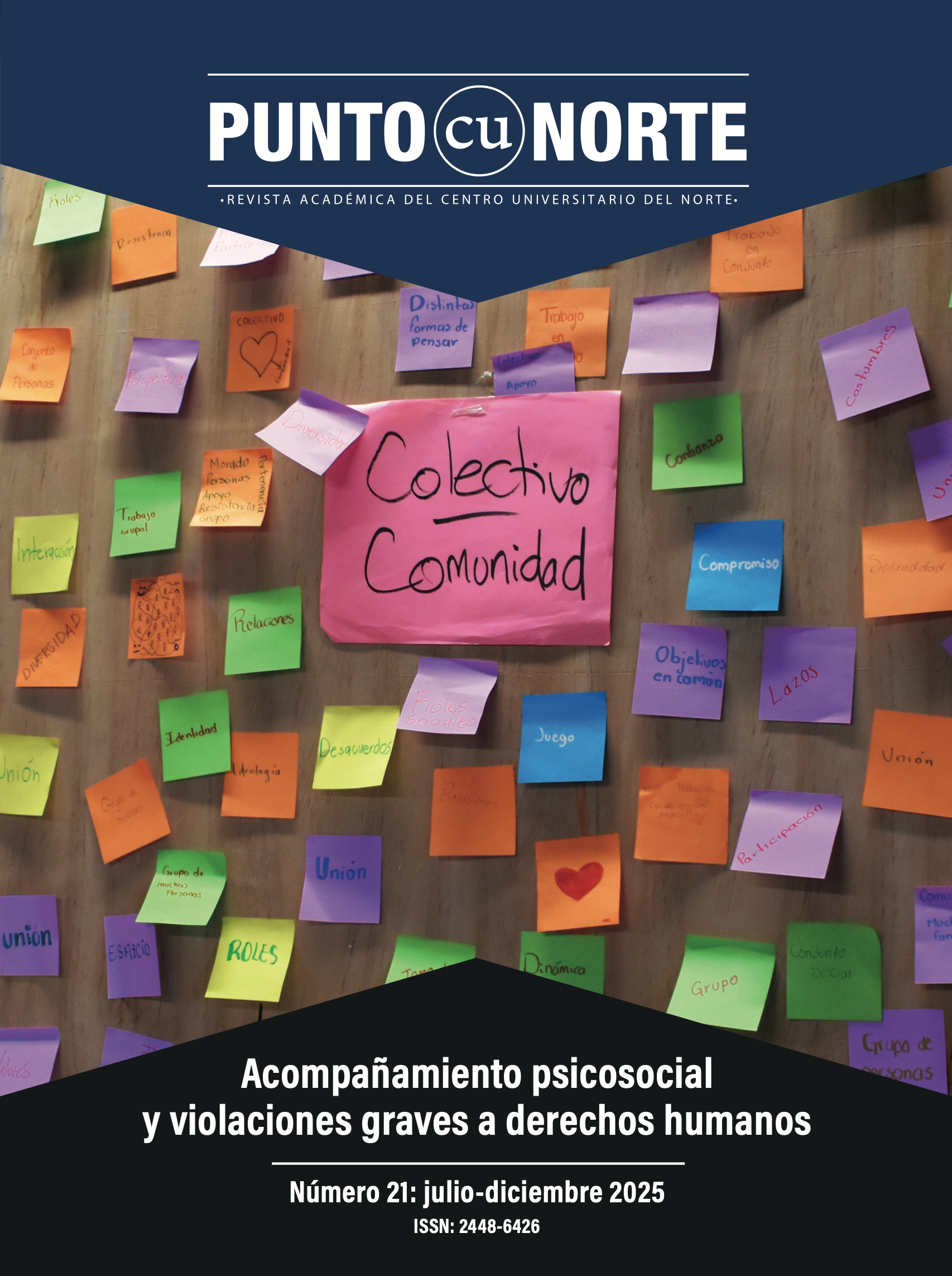
Psychosocial effects in the context of the Covid-19 pandemic in the Wixárika community of San Andrés Cohamiata
DOI:
https://doi.org/10.32870/punto.v11i21.243Keywords:
psychosocial effects, pandemic, wixarika communityAbstract
This research analyzes the psychosocial effects of the Covid-19 pandemic on the Wixarika community of San Andrés Cohamiata. It is understood that these effects arise from the interrelation between the individual and the collective, impacting not only the person but also social support networks, family and community communication, and the construction of lived experience. We seek to recognizing and analyzing the psychosocial impacts generated by the Covid-19 pandemic in the community of San Andrés Cohamiata and understanding the dimensions of these effects from the Wixarika worldview (W) with the aim of identifying and proposing appropriate action routes for the community to mitigate these effects. For this, a qualitative methodology was used, with interviews as the data collection technique. The sample consisted of 10 participants from the community.
References
Álvarez-Gayou Jurgenson, J. L. (2003). Cómo hacer investigación cualitativa: Fundamentos y metodología. Paidós Educador.
Amsel, A. (1992). Frustration theory. Cambridge University Press. Borkovec, T., Robinson, E., Pruzinsky, T. y DePree, J. (1983). Preliminary Exploration of Worry: Some Characteristics and Processes. Behaviour Research and Therapy, 21(1), pp. 9-16. https://doi.org/10.1016/00057967(83)90121-3.
Carlsen, L. (1999). “Autonomía indígena y usos y costumbres: La innovación de la tradición”. Revista Chiapas, 7(6). Consultada el 10 de octubre de 2025 en https://revistachiapas.org/No7/ch7carlsen.html.
Frankl, V. (2011). Teoría y terapia de las neurosis: iniciación a la logoterapia y al análisis existencial. Herder Editorial.
Galimberti, U. (2002). Dizionario di psicologia. Siglo xxi.
González Alonso, F. (2006). El conflicto y sus elementos. En La mediación intercultural ante conflictos en educación como modelo facilitador de la convivencia entre menores [presentación]. Instituto de Ciencias de la Educación, Universidad Pontificia de Salamanca. https://doi.org/10.13140/ RG.2.1.3432.2166.
Instituto Nacional de Estadística y Geografía (2021). “Derechohabiencia”. En Censo de Población y Vivienda 2020. Consultada el 10 de octubre de 2025 en https://www.inegi.org.mx/programas/ccpv/2020/#Microdatos.
Lafuente, J. y Camhaji, E. (2020, 28 de febrero). México confirma el primer caso de coronavirus en el país. El País. Consultada el 10 de octubre de 2025 en https://elpais.com/sociedad/2020/02/28/actualidad/1582897294_203408. html.
Laplanche, J. y Pontalis, J-b. (2008). Diccionario de psicoanálisis. Paidós. Marshall, C. y Rossman, G. B. (1989). Designing qualitative research. Sage. Martín-Baró, I. (1990). Acción e ideología: Psicología Social desde Centroamérica. UCA Editores.
Martín Beristain, C. (2010). Manual sobre perspectiva psicosocial en la investigación de derechos humanos. Instituto de Estudios Sobre Desarrollo y Cooperación Internacional.
Monje, C. (2011). Metodología de la investigación cuantitativa y cualitativa: Guía didáctica. Universidad Surcolombiana.
Núñez, C. V. (2013). Redes de apoyo psicosocial al duelo. Academia.
Organización Mundial de la Salud (OMS) (2021). COVID-19 Cases World. Consultada el 6 de septiembre de 2021 en https://covid19.who.int/.
Pérez Porto, J., Gardey, A. (2012, 11 de junio). Definición de preocupación Qué es, Significado y Concepto. Definicion.de. Última actualización el 19 de mayo de 2022. Consultada el 23 de febrero de 2023 en https://definicion.de/ preocupacion/.
Vanegas García, J. H. y Obando, L. M. (2007). La discapacidad, una mirada desde la teoría de sistemas y el modelo biopsicosocial. Hacia la Promoción de la Salud, 12(1), pp. 51-61. Consultada el 10 de octubre de 2025 en https:// revistasojs.ucaldas.edu.co/index.php/hacialapromociondelasalud/article/ view/1947.
Warman, A. (2001). Los indios mexicanos en el umbral del milenio. Fondo de Cultura Económica.
Wotjak, C. T. y Pape, H. -C. (2013). Neuronal Circuits of Fear Memory and Fear Extinction. E-Neuroforum, 19(3), pp. 47-56. https://doi.org/10.1007/s13295-013-0046-0.
Yamagishi, T. (2001). Trust as a form of social intelligence. En K. S. Cook (Ed.), Trust in Society (pp. 121-147). Russell Sage Foundation.
Downloads
Published
How to Cite
Issue
Section
License
Copyright (c) 2025 Maribel Salvador Ramírez

This work is licensed under a Creative Commons Attribution-NonCommercial 4.0 International License.
Los autores/as que publiquen en esta revista aceptan las siguientes condiciones:
De acuerdo con la legislación de derechos de autor, Punto Cunorte reconoce y respeta el derecho moral de los autores, así como la titularidad del derecho patrimonial. Bajo la iniciativa de Budapest de acceso abierto, el autor otorga derechos conexos a la Universidad de Guadalajara, al Centro Universitario del Norte y a la revista Punto Cunorte para su difusión en acceso abierto. Punto Cunorte no realiza cargos a los autores por enviar y procesar artículos para su publicación.
Los autores/as pueden realizar otros acuerdos contractuales independientes y adicionales para la distribución no exclusiva de la versión del artículo publicado en Punto Cunorte (por ejemplo incluirlo en un repositorio institucional o publicarlo en un libro) siempre que indiquen claramente que el trabajo se publicó por primera vez en Punto Cunorte.
Esta obra está bajo una Licencia Creative Commons Atribución-NoComercial 4.0 Internacional.